Modular interfaces
Each layer has a defined connector and role so a sensor or HMI can change without replacing the entire system.
TECHNOLOGY 03 / VEHICLE INTEGRATION
A safety system becomes practical when it can read vehicle state, drive lamps or buzzers, connect sensors and adapt to different platforms without a complete redesign.
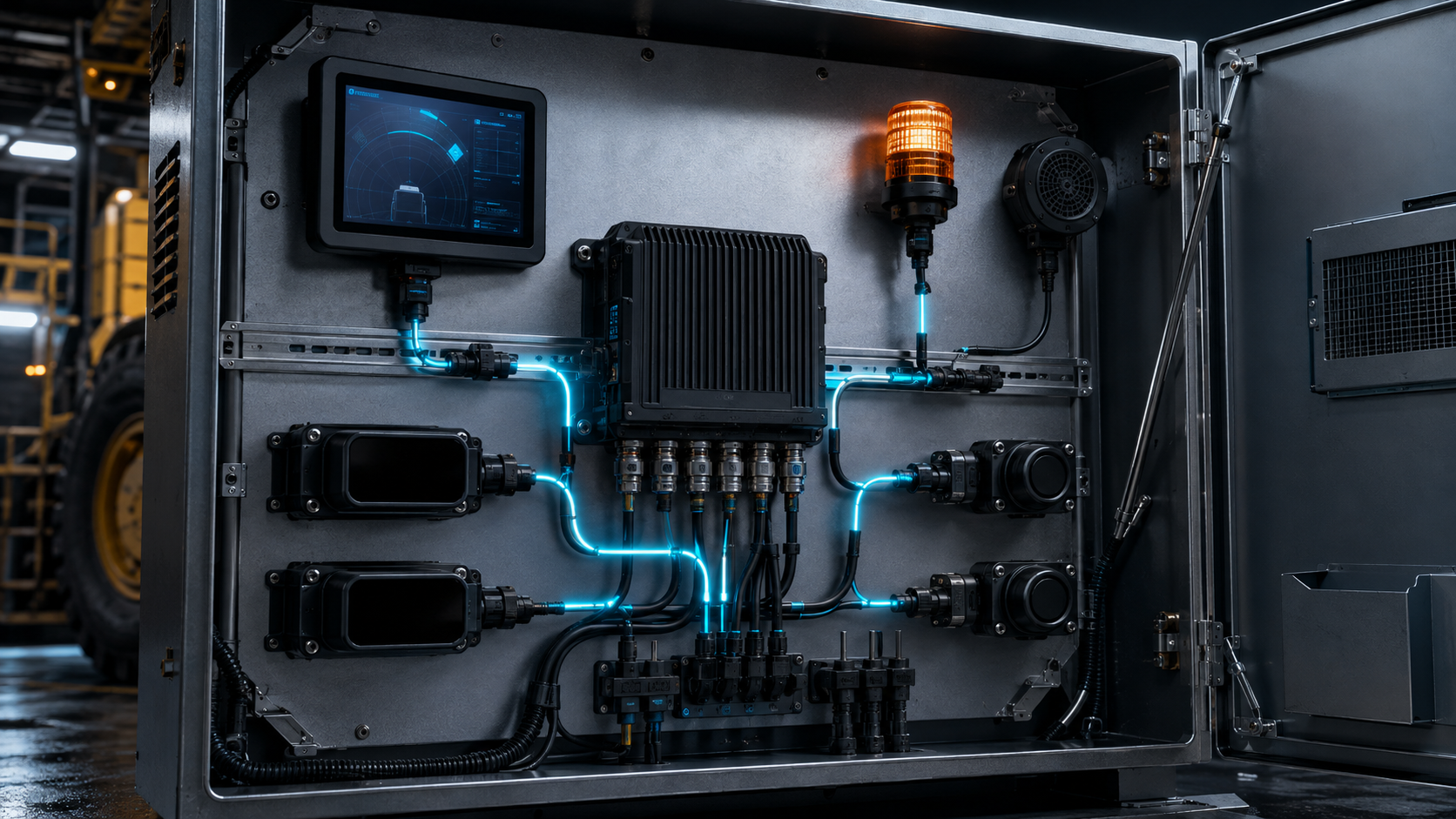
NORTHAR separates sensing, processing, interface and output layers. CAN carries vehicle-state and device messages; digital or analog I/O connects simple signals, relays, lamps, buzzers and interlocks.
REFERENCE HARDWARE KIT
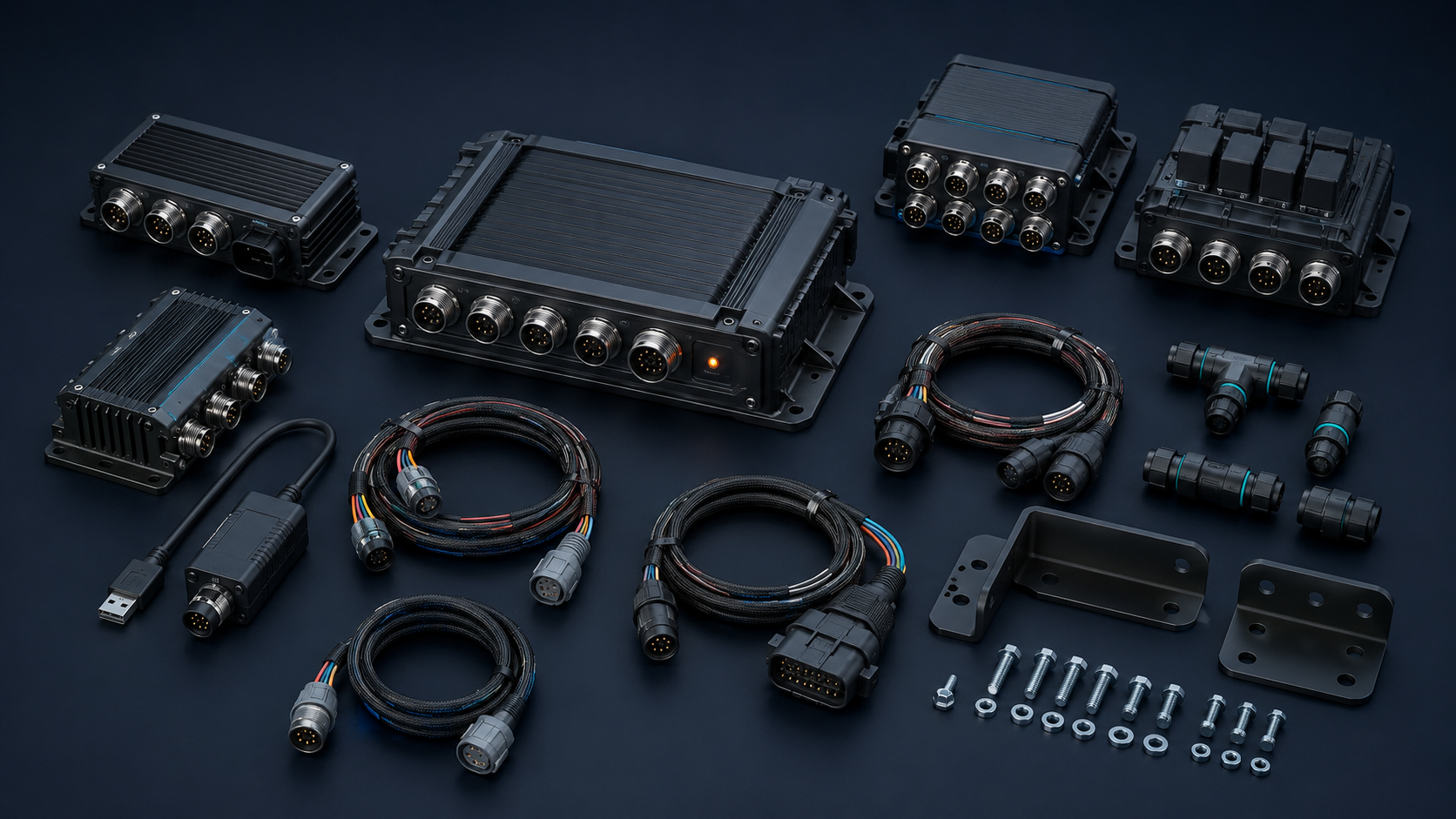
The kit is configured around the vehicle, voltage, warning zones and available interfaces. The image represents an OEM-neutral design; the final model and appearance may change after manufacturer selection.
DESIGN PRINCIPLES
Presented at architecture level; the final commercial configuration depends on the vehicle survey and safety requirements.
Each layer has a defined connector and role so a sensor or HMI can change without replacing the entire system.
CAN IDs, bus speed, voltage levels and I/O logic follow the documentation of each vehicle.
Operator warnings are different from automatic braking or motion inhibition; every intervention needs its own safety assessment.
Simple, testable and compatible with lamps, buzzers and relays.
Limited diagnostics and increasing wire count as signals grow.
A foundational compatibility layer for legacy vehicles and accessories.
Widely used, robust and suited to compact control data.
Lower payload and data capacity than CAN FD.
Primary path for integration with existing vehicles.
Larger payload and a faster data phase when the entire network supports it.
Requires compatible controllers, transceivers and nodes.
Upgrade path for additional sensing, diagnostics and faster service.
High bandwidth for cameras and central compute.
More complex network architecture, security and connectivity.
Added in advanced configurations rather than replacing CAN and I/O everywhere.
UPGRADEABLE ARCHITECTURE
The roadmap is managed by hardware, software and per-vehicle configuration versions.
Connect vehicle state, lamps, buzzers, HMI and sensors through vehicle-specific mapping.
Increase transfer capacity and support controlled software updates through a service port.
Connect cameras, edge computers or fleet systems when high bandwidth is required.
Manage per-vehicle configurations, track releases and support rollback to a stable version.
TECHNICAL REFERENCES
Share the vehicle model, dimensions, speed and blind zones. NORTHAR will propose a configuration and validation plan.
Talk to an engineer →